Every track coach knows the 800 meters is lost in the second lap. Runners who go out too fast in the first 400 arrive at the bell with nothing left, and runners who hold back too much never get a chance to kick. The race is won by a plan: know the distance, know your splits, rehearse them until the pace feels boring. A professional certification exam is not a footrace, but the logic carries over better than you might expect. This article looks at one tool built around that idea, the IAPP Artificial Intelligence Governance Professional (AIGP) practice tests from Be Ready Education, and asks who should use them and who should not.
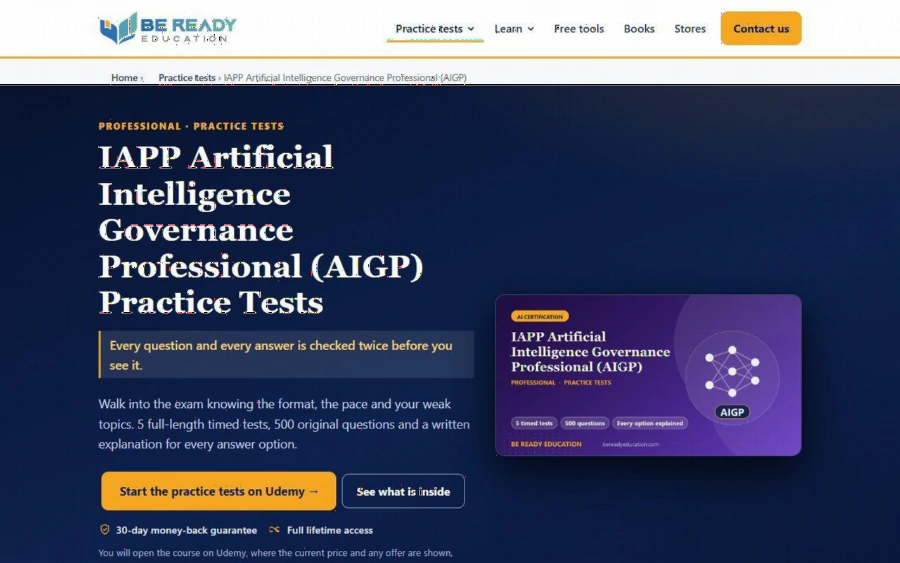
Be Ready Education page for the AIGP practice tests, showing 5 timed tests, 500 questions and a 30-day money-back guarantee
The problem: AI governance arrived before the job descriptions
Many organizations now use AI systems in hiring, customer service, fraud checks and forecasting. Someone has to answer the awkward questions. Who approved this model? What data trained it? Can we explain a decision to a regulator or a customer? In a lot of companies that someone is a privacy officer, a risk manager or a compliance lead who picked up AI as one more responsibility, often without a formal syllabus.
The AIGP is the IAPP credential aimed at that gap. According to the Be Ready Education exam page, which cites the provider's official page and was last reviewed on 1 November 2026, the exam is taken at Pearson VUE test centres worldwide or online through OnVUE remote proctoring. It runs 2.75 hours, contains 100 questions, and needs a score of 300 on a scale of 100 to 500 to pass. The page describes the subject as AI governance, risk management and compliance. It does not list domain names or weights, so you will need the provider's own exam guide for that detail.
Why pacing matters more than people expect
Do the arithmetic. 2.75 hours is 165 minutes. Spread across 100 questions, that is 99 seconds each, which the Be Ready page also states. That is a comfortable number for a straightforward question and a tight one for a scenario that asks you to weigh two defensible answers.
This is where practice tests earn their place. Reading a framework is one skill. Choosing between "provider" and "deployer" obligations, or between a voluntary guidance document and a certifiable standard, with a clock running, is another. Runners do not prepare for an 800 by reading about running. They run splits. Exam candidates should do the equivalent.
What the course actually contains
Everything below comes from the AIGP page on the Be Ready Education site, so you can check it yourself before spending anything.
- 5 full-length timed practice tests.
- 100 questions and 165 minutes per test, which matches the length and question count of the exam format the page describes.
- 500 original questions in total.
- A 60% pass mark inside the practice tests.
- A written explanation for every answer option, covering why the right one is right and why the others are wrong.
- Delivery as a Udemy course, with a 30-day money-back guarantee and full lifetime access. The page notes that refund and access terms are set by Udemy.
The page also states that the questions are original and are not actual exam content, and that Be Ready Education is not affiliated with or endorsed by IAPP. I consider that honest framing a point in its favor. If a practice product ever promises "the real questions," treat it with suspicion, because candidates agree not to share them and a legitimate provider will not have them.
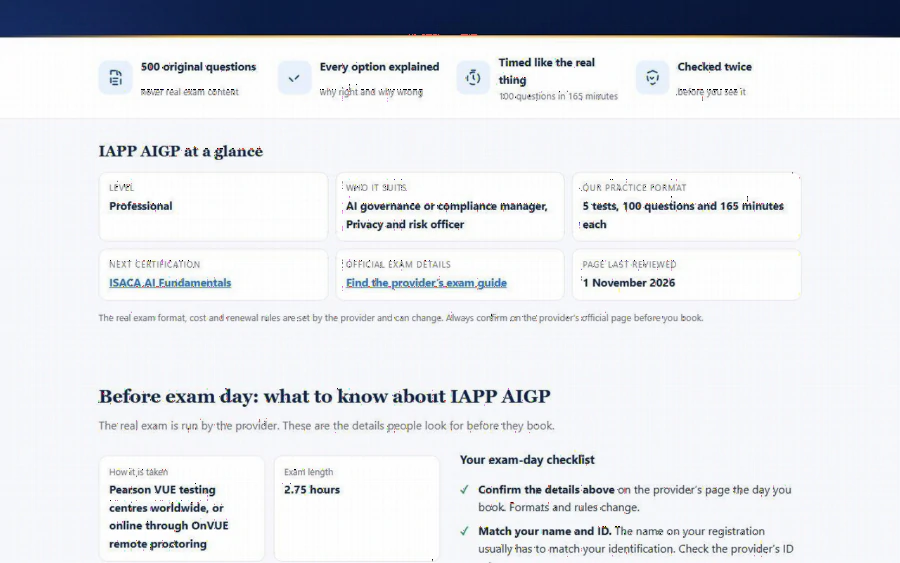
The AIGP at a glance section: 500 original questions, every option explained, 100 questions in 165 minutes
The distinctions the page says it drills
The course page highlights three pairs that tend to trip people up in governance work:
1. Provider versus deployer. Who carries which duties when one company builds a system and another puts it to work.
2. NIST AI RMF versus ISO/IEC 42001. The first is voluntary guidance, the second is a management system standard that an organization can be certified against.
3. Transparency versus explainability. Telling people an AI system is in use is not the same as being able to explain how it reached a given output.
These are good choices because they are the kind of distinction a scenario question hides inside a long paragraph. Explanations on every answer option matter here. If you only learn that option C is correct, you have a memory. If you learn why B and D were tempting and wrong, you have a way to reason through a new question.
Free tools worth using before you pay
The page lists several free tools: an exam timer, a pass score calculator, a practice score tracker, and study plans of two weeks and four weeks. There is also a readiness check that takes your practice score and your exam date. According to the page, nothing you enter is saved or sent anywhere.
The suggested target is 70% or more on two tests in a row. I like this rule because it guards against the most common self-deception in test prep, which is one good score after seeing the same material twice. Two consecutive results at that level, on tests you have not seen, is a steadier signal. It is still a signal and not a promise.
Strengths and limits, stated plainly
Strengths. The format maps closely to the exam length and question count the page describes. The explanations cover every option. The pricing is handled on Udemy with a refund window, so you can judge the quality before you are locked in. The free tools lower the cost of trying the approach.
Limits. Practice questions teach recognition and pacing, not the underlying body of knowledge. If you have never read about AI risk frameworks, five mock tests will mostly show you what you do not know. Also, the page does not show a price, because the current price and any offer appear on Udemy, so you will need to check there. And no practice product can change the fact that the provider sets and updates the real exam. The page itself advises confirming details on the official source before you book.
The page also makes a sensible point about expectations: a certificate supports an application, but it does not guarantee a job.
Who should use it, and who should skip it
It suits an AI governance or compliance manager, or a privacy and risk officer, which is exactly the audience the page names. It also fits someone who has already studied the official material and now needs timed repetition to find weak topics.
It is a weaker fit for a complete beginner who wants a first introduction to AI governance. Start with the provider's own guide and some reading, then come back to practice tests when you can finish a sample set without guessing. If you are still deciding between certifications, the page points to ISACA AI Fundamentals as a next step, and the wider Be Ready Education exam library lets you compare other options.
A simple way to start
1. Read the provider's official exam guide first and note the domains it lists.
2. Use the free timer and one of the two study plans to set your weekly schedule.
3. Take the first practice test cold, under the full 165 minutes, with no notes.
4. Review every explanation, including for the questions you got right by luck.
5. Track your score after each test and look for the same weak topic appearing twice.
6. When you hit 70% or more on two tests in a row, book the exam on the provider's site and confirm the details that day.
Back to the track for one last thought. The best coaches do not tell runners to try harder in the final lap. They make sure the pace was rehearsed so well that the final lap is just the plan carrying on. Practice tests will not make the material easier, but they can make the clock familiar, and for a 99-seconds-per-question exam that is worth a lot. If that fits your situation, the AIGP course page has the full details and the link to start on Udemy.